
 |  |  |  |  |  | |
 |  |  |  | |||
Reason to SingApril 15, 2018 |
 Read: Psalm 98  Sing to the Lord a new song, for he has done marvelous things.—Psalm 98:1 When I was thirteen, my school required students to take four exploratory courses, including home economics, art, choir, and woodworking. On my first day in choir, the instructor called each student to the piano individually to hear their voices and place them in the room according to their vocal range. During my turn at the piano, I sang the notes she played multiple times, but wasn’t directed to a section in the room. Instead, after repeated tries, she sent me to the counseling office to find a different class to take. From that moment on, I felt I shouldn’t sing at all, that my voice shouldn’t be heard in song. I carried that thought with me for more than a decade until I read Psalm 98 as a young adult. The writer opens with an invitation to “sing to the Lord” (Psalm 98:1). The reason offered has nothing to do with the quality of our voices; He delights in all His children’s songs of thanksgiving and praise. Instead, we are invited to sing because God “has done marvelous things” (v. 1). The psalmist points out two wonderful reasons to joyfully praise God in song and in attitude: His saving work in our lives and His ongoing faithfulness toward us. In God’s choir, we each have a place to sing of the marvelous things He has done. —Kirsten Holmberg Lord, You have done great things in my life. Even if my voice isn’t one that would be heard on stage, I want to join the choir in thanking You for the amazing things You’ve done. God loves to hear the voices of His children. INSIGHT: Hallel is the Hebrew word for “praise” and aptly describes many of the psalms, including Psalm 98. Within the Hebrew psalter, however, there is a subset of hymns called the Hallel Psalms (Psalms 113-118). These psalms were normally sung or recited during high feast times, including Passover—Psalms 113-114 before the meal and Psalms 115-118 after it. The Jewish day begins at dusk, so when Jesus shared a final Passover with His men, crucifixion day had already begun. In the context of the cross, the impact of singing Psalm 118:24 takes on new meaning: “This is the day which the Lord has made; let us rejoice and be glad in it” (nasb). And knowing these words would have been on the Savior’s lips as He moved toward Calvary provides vivid commentary on Hebrews 12:2: “For the joy set before him he endured the cross, scorning its shame, and sat down at the right hand of the throne of God.” Why not take a moment to joyfully praise the Lord for all He has done? |
| You can make a difference. Even the smallest donation helps reach people around the world with the life-changing wisdom of the Bible.
|
Share With Your Friends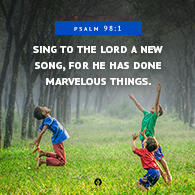 | Featured Video  |
 Our mission is to make the life-changing wisdom of the Bible understandable and accessible to all. Our vision is to see people of all nations experiencing a personal relationship with Christ, growing to be more like Him, and serving in a local body of His family. To read today's Our Daily Bread online visit www.odb.org. Scriptures taken from Holy Bible, New International Version®, NIV® Copyright © 1973, 1978, 1984, 2011 by Biblica, Inc.® Used by permission. All rights reserved.
Our Daily Bread Ministries | PO Box 80125 | Lafiaji Post Office | Lagos State 101006
|




No comments:
Post a Comment